SorbiTech Catalyst Bed Support Grading Ceramic Alumina Balls Graded Reactor Bed Support
Products

Support Media & Bed Accessories

Product groups 4 (Ceramic · Alumina · Pads · Grid)
Size range 6 to 25 mm graded sets
Alumina purity 99 to 99.7 percent
Manufacturing ISO 9001:2015
Adsorbent Family · Manufactured to ISO 9001:2015

Inert ceramic and alumina balls, support grids, and compression pads for packed bed vessels under pressure swing or temperature swing cycling.

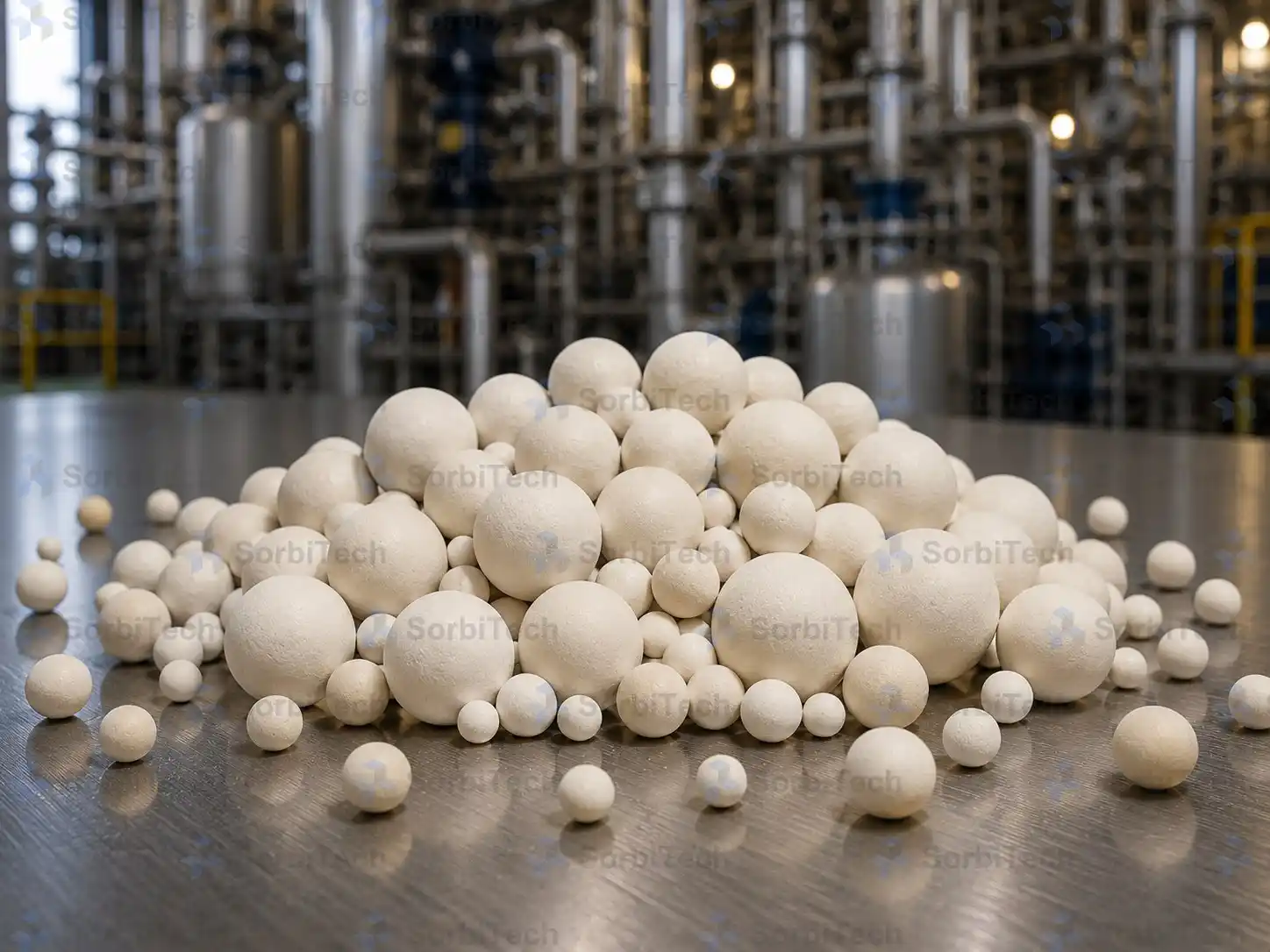
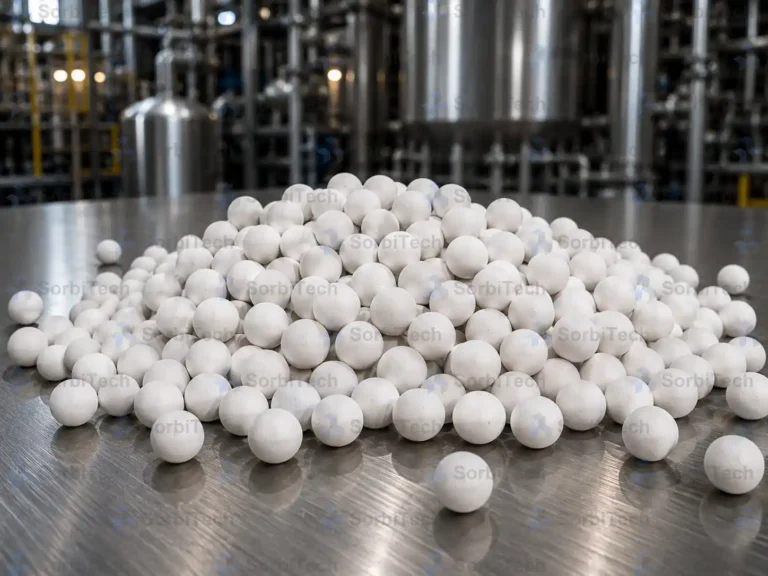
The support media range covers four product groups used inside packed bed vessels. Inert ceramic balls of 99 percent alumina for general support and grading. High purity inert alumina balls of 99.7 percent purity for service in contact with precious metal catalysts. Rubberised compression pads, also known as CFL mats, used as a hold down layer at the top of the bed. Underdrain support grids and screens used at the bottom of the vessel.

The ceramic and alumina balls are produced by isostatic pressing of high purity feed, followed by sintering at controlled temperature. The grades are sized to the sieve cut and packaged in 25 kg bags. Compression pads are cut from continuous rolls of phenolic bonded glass fibre felt to the customer drawing.

In service the support media is silent infrastructure. It does not adsorb, react, or catalyse. Its purpose is mechanical. It carries the load of the active bed above, distributes the inlet flow uniformly across the vessel diameter, prevents fines migration into the underdrain, and dampens the pressure cycling shock that would otherwise abrade the active bed. A correctly graded support layer is invisible to the operator but extends bed life by years.

Mechanism

Support media is silent infrastructure. It does not adsorb. It carries the load, distributes the flow, and prevents fines migration into the underdrain.

order of magnitude with compression Attrition reduction
inspected and reinstalled at change out Reusable
How It Works

Flow Distribution and Mechanical Containment

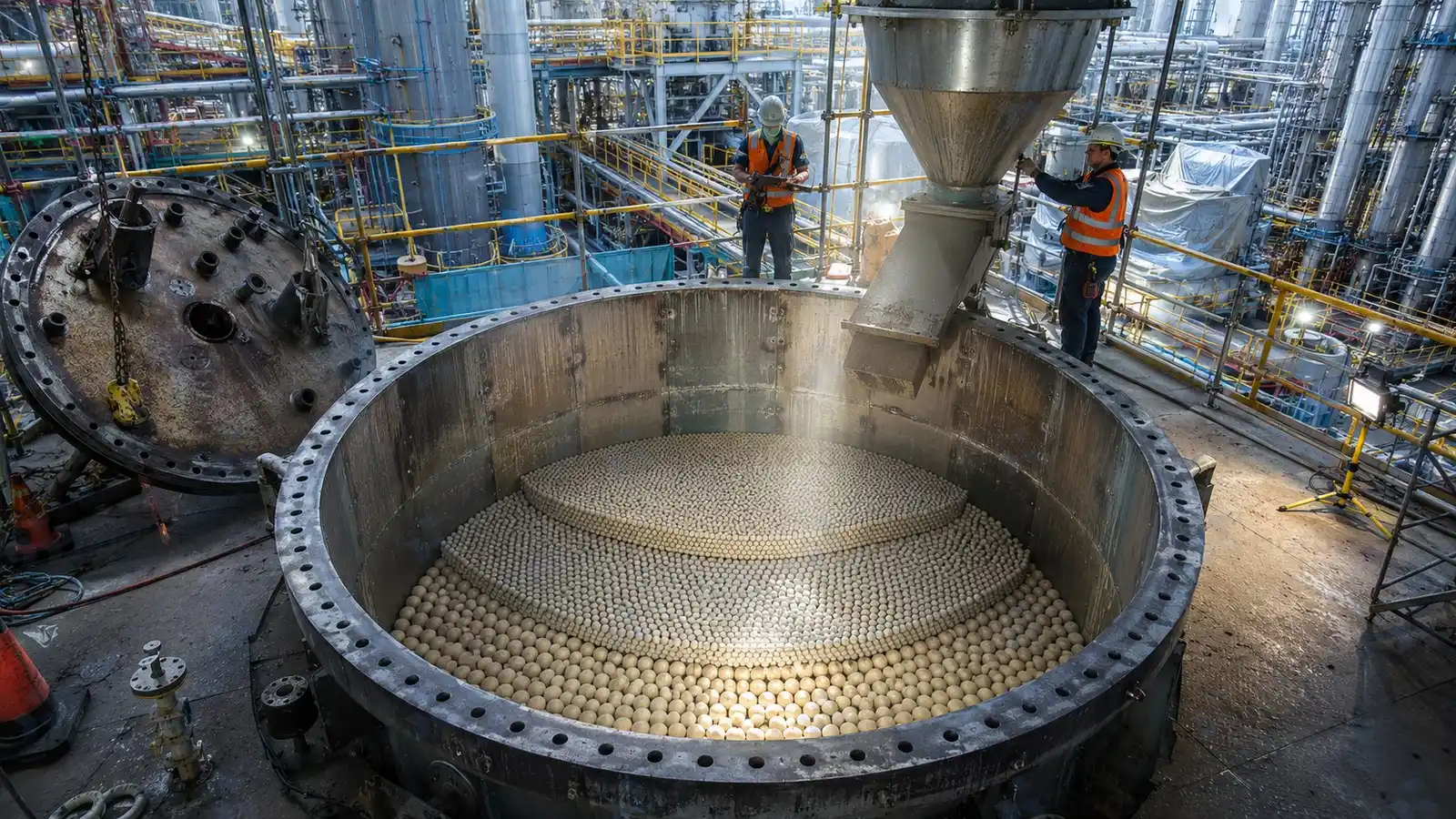
The support layer at the bottom of an adsorber is sized by the underdrain spacing of the vessel and by the particle size of the active bed above. Graded sets typically run 25 mm at the very bottom, stepping down to 13 mm, then 6 mm, then matching the active bed particle size. This stepwise grading prevents the smaller active particles from migrating down into the underdrain and creating channels.

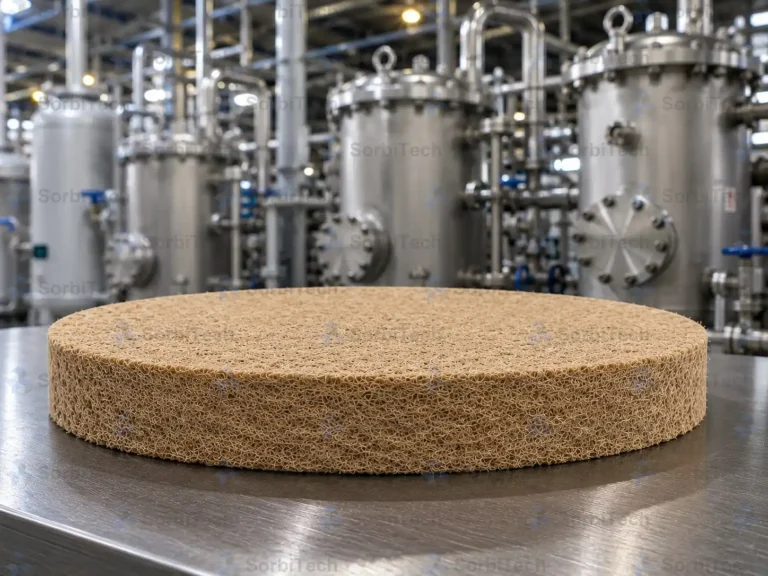
The compression pad layer at the top of the bed solves a different problem. During depressurisation in a PSA cycle, or during start of cycle gas surge, the active bed lifts and the particles abrade against each other and against the vessel wall. The compression pad holds the bed under uniform light load, preventing the lift and reducing attrition loss by an order of magnitude on cycling service.

SorbiTech Ceramic Support Balls Reactor Bed Support Media
SorbiTech Manufacturing
Raw Material & Manufacturing

Manufactured by isostatic pressing of high purity alumina

The ceramic and alumina ball range is produced by SorbiTech from high purity alumina powder. The powder is mixed with a binder, formed into spheres by isostatic pressing or by rolling, and sintered at 1500 to 1700 °C to develop full ceramic density. The standard 99 percent alumina ball is suitable for general support duty. The high purity 99.7 percent alumina ball is suitable for contact with precious metal catalysts.

The compression pads, also known as CFL mats, are cut from continuous rolls of phenolic bonded glass fibre felt to the vessel internal diameter on customer drawing. Underdrain grids and screens are fabricated from stainless steel to the vessel design. Every ball lot is sampled for crush strength, attrition loss, and bulk density. Documentation is provided with every shipment.

Grades in the Family

Available Grades and Specifications

Each grade is a defined product with its own technical data sheet, certificate of analysis, and engineering selection guidance. Open a grade for the full specification, applications, and lifecycle service notes.

SorbiTech Inert Alumina Balls Catalyst Bed 99 Purity Inert Media
Grade

Inert Alumina Balls

BET surface
Inert · < 0.5 m²/g m²/g
Form
3 mm · 6 mm · 13 mm · 19 mm · 25 mm
Crush
Very high (above ceramic clay equivalents) N
Bulk density
1.50–1.70 g/ml

High purity alumina balls for high temperature catalyst bed support, thermal mass, and aggressive chemical service.
SorbiTech Ceramic Support Balls Reactor Bed Support Media
Grade

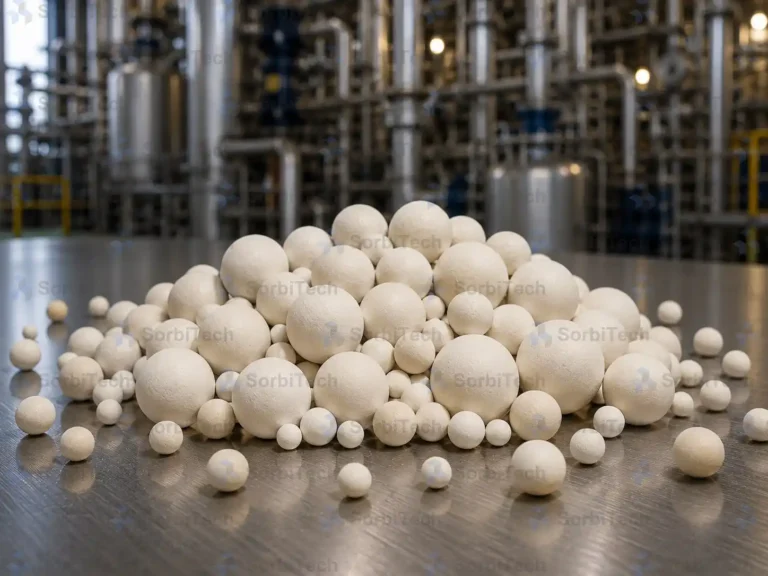
Ceramic Support Balls

Form
3 mm · 6 mm · 13 mm · 19 mm · 25 mm · custom
Crush
Very high (3,000 to 8,000 N per ball depending on size) N
Bulk density
1.30–1.50 g/ml

Inert ceramic balls for adsorber bed support, flow distribution, and graded bed transitions.

Why SorbiTech

Engineered media, supported through the bed life

The SorbiTech group covers media supply, engineering design, lifecycle service, and quality documentation under a single accountability. The bead and the bed are one decision.

Engineered, Not Traded

The grade shipped is the grade engineered into the vessel design. SorbiTech designs the dryer, sizes the bed, and supplies the media as one decision.

Lot Traceability per Shipment

Every shipment ships with a certificate of analysis covering iodine number, water capacity, crush strength, attrition loss, and bulk density measured against the lot.

Lifecycle Service Contract

The bed is supported through its service life. Field sampling, performance audit, reactivation logistics, and end of life return are covered under one service agreement.

Cross Disciplinary Team

Process engineers, mechanical designers, and lifecycle specialists work the same project. The recommendation closes against duty data, not against a catalogue page.

Engineering Guidance

Which Grade for Which Duty

Starting point for grade selection. The final specification is closed out after the SorbiTech engineering team receives duty data, inlet composition, and the target outlet condition.

Duty or Target
Recommended Grade
Standard adsorber bottom support layer
Ceramic balls 99 percent alumina, graded set from 25 mm to active bed size.
Inert topping for precious metal catalyst beds
High purity alumina balls, 99.7 percent purity, sized 6 to 13 mm.
Top of bed compression for PSA cycling service
Phenolic bonded compression pads, cut to vessel internal diameter.
Underdrain support in water treatment filter
Ceramic balls in 6, 13, and 25 mm grades, layered above the underdrain.
Engineering FAQ

Common Questions on Support Media & Bed Accessories

What is a graded support set?

A graded set is a layered arrangement of inert balls, with the largest size at the bottom in contact with the underdrain and successively smaller layers above, matching the active bed particle size at the top of the support layer. The grading prevents the active bed particles from migrating down into the underdrain.

When do I need high purity alumina rather than standard ceramic?

When the support layer is in contact with a precious metal catalyst, silica or iron impurities from a standard ceramic ball can migrate to the catalyst surface during the operating life of the bed and reduce its activity. High purity 99.7 percent alumina eliminates this risk.

How much does the compression pad reduce attrition loss?

An order of magnitude on heavy PSA cycling service. A bed that loses 1 to 2 percent of its mass per year to attrition without the pad will lose 0.1 to 0.2 percent with the pad correctly installed. The pad investment pays back in a single bed life extension.

Can I reuse the support media at the next change out?

Yes. The ceramic and alumina balls are inert and do not degrade in service. They are recovered at change out, washed, inspected for breakage, and reinstalled with the new active bed. Compression pads are replaced because the phenolic binder ages and the felt loses its spring.

How is the support layer sized?

By the underdrain spacing of the vessel and by the particle size of the active bed. The vessel fabricator specifies the underdrain. The active bed specifies the smallest support size. The intermediate grades fill the gap with a 2 to 3 ratio between successive layers.

Specify the Right Grade with the SorbiTech Engineering Team

Submit process duty data and receive a written recommendation with grade, sizing, packaging, and lead time.