
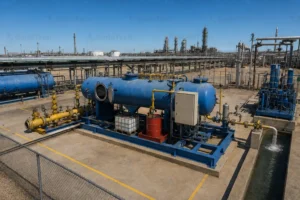
CPI Oil Water Separator
Corrugated plate interceptor that separates free oil and settleable solids from produced and industrial water to below 10 ppm. Compact, with no moving parts.
Capacity: 5–500 m³/h

The inlet stage that sets the operating conditions for every downstream treatment system. Corrugated plate interceptors designed to the actual inlet load, not the steady state average.
The performance of the CPI separator at the inlet of a treatment train sets the operating conditions for every downstream stage. A separator that delivers oil above 50 mg per litre at the outlet overloads a coalescing skid designed for a 10 to 50 mg per litre inlet. A separator that passes fine solids blinds a granular activated carbon bed. The separator is not just the first item in a list of equipment. It is the stage whose sizing and commissioning determines whether the downstream treatment train operates within its design envelope or outside it.
SorbiTech designs CPI oil and water separators for produced water separation in upstream and midstream oil and gas operations, for refinery effluent at battery limits prior to secondary treatment, for vehicle and equipment wash water at industrial facilities, and for compressor condensate at gas compression stations. In each case the separator is designed against the actual inlet load, including the peak flow rate, the maximum inlet oil concentration, the solids load at start-up and upset conditions, and the operating temperature range.
A design margin of 25 percent on the rated plate pack velocity is applied as standard, maintaining separation efficiency during flow surges. Where the outlet from the CPI feeds a downstream coalescing stage and a carbon polishing bed, SorbiTech designs the full treatment train as one system. The outlet oil target of the separator is set to the inlet the coalescer requires. One performance guarantee covers the full train outlet.
The corrugated plate pack changes the effective geometry of gravity separation. Instead of rising the full depth of the vessel, an oil droplet only needs to rise the perpendicular distance between adjacent inclined plates, typically 20 to 30 mm. Solids fall down the corrugated profile to the vessel floor. Both mechanisms operate continuously without interfering with each other.
The design principle is the Stokes terminal rise velocity for an oil droplet in water. In an open gravity tank the droplet must reach the liquid surface by rising the full vessel depth. In a corrugated plate interceptor the droplet only needs to rise the perpendicular distance to the nearest plate surface, typically 20 to 30 mm. Once the droplet contacts the plate it coalesces with adjacent droplets, grows, and migrates along the plate to the oil collection trough at the top of the separator. The reduction in the required rise distance by a factor of 20 to 50 is the engineering basis for the size advantage of the CPI over an equivalent open tank.
The inclined plate geometry at 45 to 60 degrees to the horizontal serves a secondary purpose for solid particles. Solids entering the plate channels settle against the lower plate surface and slide down the corrugated profile under gravity to the vessel floor sludge compartment. SorbiTech calculates the critical flow velocity through the plate pack at which turbulence would re-entrain settled solids, and sets the design flow at 75 percent of that critical velocity to maintain the required margin across the expected flow range.

SorbiTech supplies CPI separators in atmospheric and pressure rated configurations. Atmospheric vessels are fabricated for surface drainage, low pressure produced water, and wash water applications. Pressure rated vessels are designed to ASME Section VIII Division 1 for inlet pressures from 1.5 to 10 barg for wellhead and process vessel applications.
For sour service above the NACE MR0175 H2S partial pressure threshold, the vessel shell, heads, nozzles, and wetted internals are specified to NACE MR0175. Welds are hardness controlled and receive post weld heat treatment. A nitrogen blanket connection on the vapour space limits H2S accumulation above the liquid surface. The documentation package contains material test reports, weld maps, hardness records, post weld heat treatment certificates, and the pressure test certificate, compiled in one engineering data book.
Each system page carries the duty specification, the media grade, the vessel configuration, and the engineering selection guidance for that equipment type.
Corrugated plate interceptor that separates free oil and settleable solids from produced and industrial water to below 10 ppm. Compact, with no moving parts.
Capacity: 5–500 m³/h
When the adsorbent specification and the vessel design come from different suppliers, the performance guarantee has a gap between them. SorbiTech closes that gap by calculating both in one engineering record.
The adsorbent grade, the bed volume, the vessel wall thickness, and the cycle parameters are solved in one engineering calculation. The media specification is not issued separately from the equipment specification. There is one calculation record and one performance guarantee.
The contracted outlet condition, whether a dew point in degrees C, an oil concentration in mg per litre, or a product purity in percent, is the guarantee. SorbiTech measures the outlet at commissioning against the stated inlet conditions and issues the guarantee against the measurement.
All pressure vessels are fabricated to a named pressure vessel code. Third party inspection is appointed for all vessels regardless of pressure class. NACE MR0175 materials and post weld heat treatment are applied to sour service duty without a separate qualification process.
Scheduled media sampling and laboratory activity testing track bed performance against the design specification. When the bed reaches the end of its service life, the reload is carried out under the original process calculation. The performance guarantee restarts after reload.
Starting point for the engineering conversation. The final specification closes after SorbiTech receives the inlet composition, the operating window, and the target outlet condition.
A correctly designed CPI separator removes free oil droplets above 60 to 150 micron, depending on the plate spacing, the superficial velocity through the plate pack, and the oil and water density difference at operating temperature. Droplets below 60 micron are dispersed or emulsified and pass through the separator. These are handled by the downstream coalescing stage, designed specifically for the dispersed fraction that the CPI passes at normal operating conditions.
To maintain the velocity through the plate channels below the critical resuspension velocity for settled solids and below the critical shear velocity for coalesced oil droplets during flow surges above the rated normal duty. Without this margin, a flow increase of 10 to 15 percent above rated can resuspend the sludge layer, carry solids into the downstream coalescing stage, and cause the separator outlet to exceed the design oil specification.
At an interval set by the inlet solids load, typically six to twenty-four months. Heavy solids loads from wellhead duty with fine sand or scale shorten the interval. Cleaning requires isolating and depressurising the separator, draining, and removing the plate pack sections for washing. SorbiTech designs the plate pack with removable sections sized to be handled by two operators, allowing cleaning without confined space entry where the vessel diameter permits.
No chemical dosing is required under normal operating conditions. Where the inlet oil forms a stable emulsion that does not break by gravity and plate interception within the designed residence time, a demulsifier may be required upstream. The required demulsifier type and dose rate are determined by bottle testing on a representative sample of the actual inlet emulsion. SorbiTech includes a chemical injection point on the separator inlet manifold when this provision is specified.
Provide your duty conditions and our team will recommend the right system configuration, media grade, and delivery scope.
Tell us briefly what you need. Our technical team responds within one business day.
Request the TDS / datasheet. We send it on email after a brief review.