
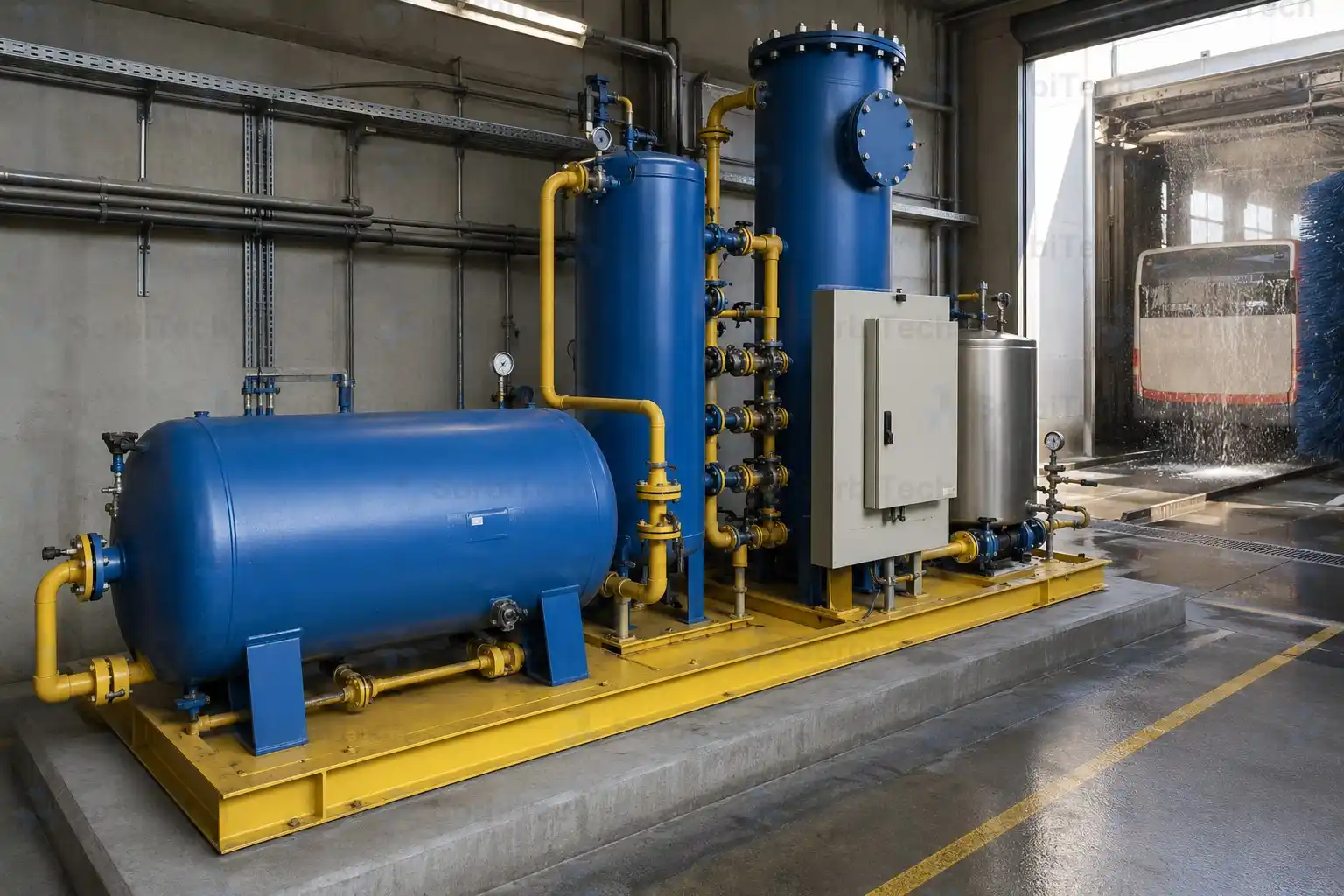
Vehicle Wash Water Recycling Skid
Compact wash water recycling skid for car, truck, bus, and heavy equipment wash bays with staged CPI separation, coalescing polishing, and activated carbon adsorption.
Capacity: 0.5–50 m³/h

Three systems serving three different missions: community public health, gold value recovery from leach circuits, and industrial wash water reuse.
The three systems in this category share the adsorption principle but serve entirely different economic and social purposes. Defluoridation protects the health of communities that depend on fluoride bearing groundwater. The WHO drinking water guideline of 1.5 mg per litre is the design target. The system must function reliably at village scale, operated by local personnel with limited specialist training, using dilute caustic solution for regeneration that can be procured and handled safely in the field.
The CIP and CIL gold carbon plant serves a fundamentally different purpose. The activated carbon here does not treat a waste stream. It recovers a valuable product from a process stream. The gold cyanide complex adsorbed from the leach solution is worth more per kilogram than the carbon that carries it. The engineering discipline in a gold carbon plant is tracking where the gold is at every stage: how much is in the loaded carbon, how much transfers in elution, how much plates in electrowinning, and how much activity the carbon retains after each reactivation cycle.
Vehicle wash water recycling addresses resource efficiency at industrial facilities where fresh water consumption and trade effluent disposal costs are both significant. A CPI separator removes free oil and settleable solids from the wash bay drain. A multi media filter removes remaining suspended solids. A granular activated carbon bed removes dissolved organics and residual surfactants. The recycled water re-enters the wash circuit, reducing fresh water intake and the volume of trade effluent that must be treated and discharged.
Activated alumina removes fluoride by ion exchange at the aluminium oxide surface: fluoride ions displace surface hydroxyl groups and bond to the aluminium sites. Activated carbon recovers gold cyanide complex by physical adsorption in the carbon micropores. The regeneration route follows the mechanism: caustic solution restores the alumina; thermal reactivation at 850 degrees C restores the carbon.
Activated alumina defluoridation works by surface ion exchange. Fluoride ions in solution displace hydroxyl groups from the aluminium oxide surface and bond to the aluminium sites. The reaction is pH dependent: SorbiTech designs the system to operate at pH 6.0 to 6.5, the range of optimal fluoride uptake. Above pH 8 the surface charge reverses and fluoride adsorption collapses. Dilute caustic solution passed through the bed in reverse flow restores the surface hydroxyl groups. Each kilogram of activated alumina completes 200 to 500 adsorption and regeneration cycles before the capacity falls below the level where continued operation is more economic than replacement.
Activated carbon adsorbs gold cyanide complex by van der Waals attraction and electrostatic interaction between the gold cyanide anion and the positively charged carbon surface in the alkaline cyanide leach medium. Coconut shell carbon with an iodine number above 1000 mg per gram provides the micropore volume required for effective gold loading. Loaded carbon leaves the leach circuit and enters the elution vessel where heated caustic cyanide solution at 90 to 120 degrees C strips the gold from the carbon surface. The eluate feeds the electrowinning cell where current deposits the gold as a sponge on the cathode. The stripped carbon enters the rotary kiln at 850 degrees C, which burns off organic residues and restores 85 to 95 percent of the original micropore surface area.

Community defluoridation units are engineered for throughputs of 10 to 500 cubic metres per day, covering drinking water demand for villages of 500 to 50,000 people. The package is assembled and tested in the workshop before delivery. Site activities are limited to civil tie-in and electrical connection. Operator training is a standard part of the supply. The operating manual specifies the regeneration chemical quantities, the cycle length between regenerations, and the bed capacity test procedure that indicates when the alumina requires replacement.
CIP and CIL gold carbon plants are scaled to the leach circuit mass balance: the gold tenor in the leach solution, the number of tanks in the circuit, and the target carbon loading differential between the lead and tail tanks. SorbiTech models the counter current carbon flow through the circuit, sizes the elution vessel and the electrowinning cell to match the production rate, and designs the reactivation kiln capacity to the carbon throughput. The gold tracking programme, recording inventory, elution efficiency, and reactivation activity at each campaign, is set up and handed over during commissioning.
Each system page carries the duty specification, the media grade, the vessel configuration, and the engineering selection guidance for that equipment type.
Compact wash water recycling skid for car, truck, bus, and heavy equipment wash bays with staged CPI separation, coalescing polishing, and activated carbon adsorption.
Capacity: 0.5–50 m³/h
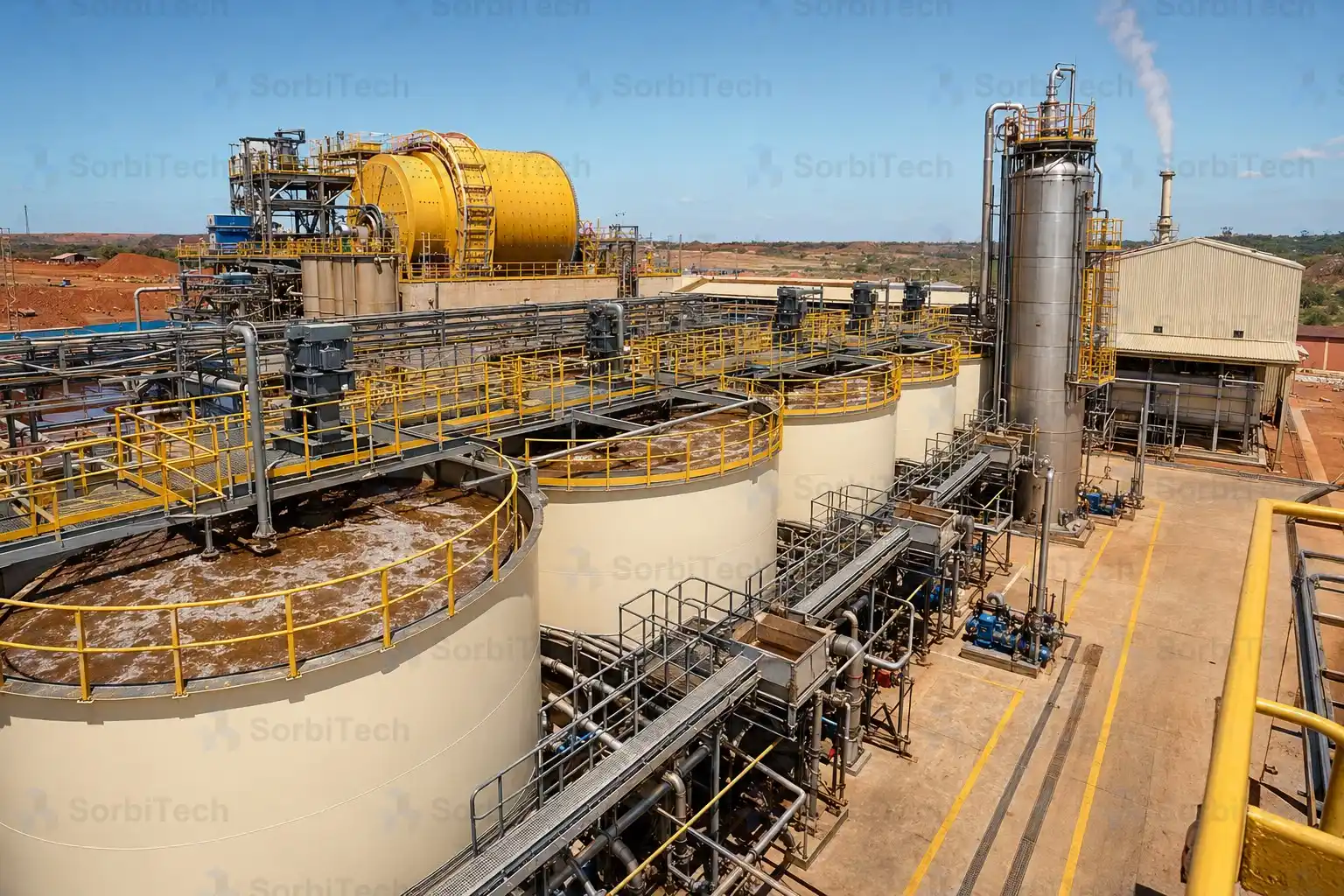
Carbon in pulp (CIP) and carbon in leach (CIL) gold recovery plant using high activity coconut shell granular activated carbon to recover gold cyanide from leach slurry.
Capacity: 10–200 t/h ore throughput
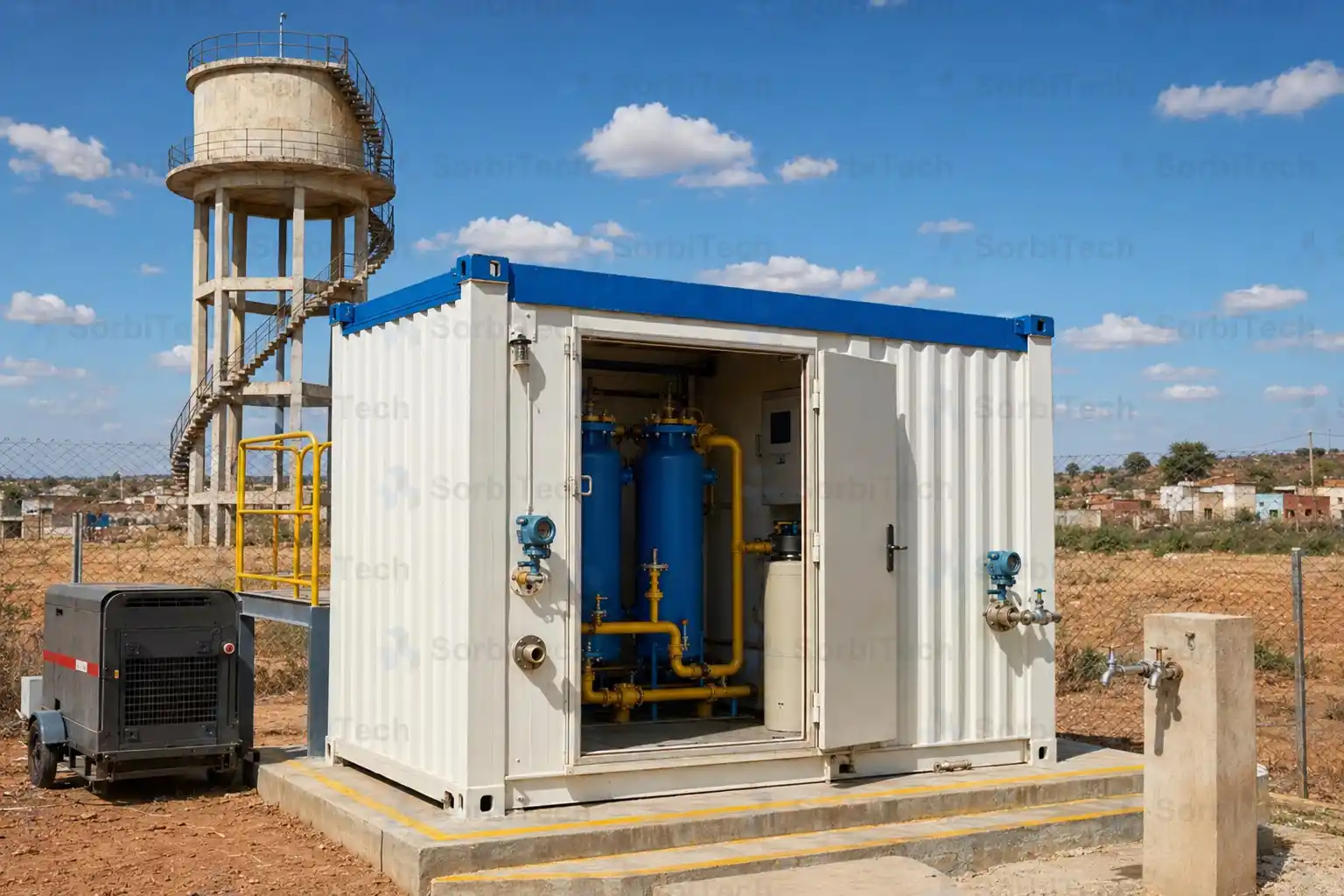
Containerised activated alumina defluoridation unit for community and decentralised drinking water supply to the WHO guideline of 1.5 mg per litre.
Capacity: 0.5–50 m³/h
When the adsorbent specification and the vessel design come from different suppliers, the performance guarantee has a gap between them. SorbiTech closes that gap by calculating both in one engineering record.
The adsorbent grade, the bed volume, the vessel wall thickness, and the cycle parameters are solved in one engineering calculation. The media specification is not issued separately from the equipment specification. There is one calculation record and one performance guarantee.
The contracted outlet condition, whether a dew point in degrees C, an oil concentration in mg per litre, or a product purity in percent, is the guarantee. SorbiTech measures the outlet at commissioning against the stated inlet conditions and issues the guarantee against the measurement.
All pressure vessels are fabricated to a named pressure vessel code. Third party inspection is appointed for all vessels regardless of pressure class. NACE MR0175 materials and post weld heat treatment are applied to sour service duty without a separate qualification process.
Scheduled media sampling and laboratory activity testing track bed performance against the design specification. When the bed reaches the end of its service life, the reload is carried out under the original process calculation. The performance guarantee restarts after reload.
Starting point for the engineering conversation. The final specification closes after SorbiTech receives the inlet composition, the operating window, and the target outlet condition.
Inlet concentrations up to 15 mg per litre are within the standard design envelope. Above 15 mg per litre, a dilution stage or an increased bed volume to flow ratio is required to maintain the outlet below the WHO guideline of 1.5 mg per litre through the full service cycle. The bed is designed to reach the 1.0 mg per litre outlet at mid-cycle, providing a safety margin before the regeneration trigger.
A well operated bed completes 200 to 500 adsorption and regeneration cycles before the fluoride capacity falls to 60 percent of the virgin value and replacement becomes more economic. The decline rate depends on the inlet water chemistry. Hardness, silica, and phosphate compete for alumina surface sites and accelerate capacity loss. SorbiTech specifies the inlet conditioning required to protect bed service life and includes the capacity monitoring protocol in the operating manual.
Overall gold recovery from leach solution to bullion is 90 to 97 percent across the adsorption, elution, and electrowinning stages under normal operating conditions. The adsorption efficiency, the elution transfer efficiency, and the electrowinning cathode efficiency each contribute to the overall figure. SorbiTech tracks gold at each stage during commissioning and identifies the point of greatest loss, allowing the circuit to be optimised toward the upper end of the recovery range.
A treatment train of CPI separation, multi media filtration, and granular activated carbon polishing reduces free oil to below 10 mg per litre, suspended solids to below 5 mg per litre, and dissolved organics to a level that does not stain or damage vehicle surfaces. The recycled water quality is suitable for vehicle exterior washing. SorbiTech sizes the treatment train to the measured inlet chemistry from the wash bay drain and the outlet quality required for the intended reuse.
Provide your duty conditions and our team will recommend the right system configuration, media grade, and delivery scope.
Tell us briefly what you need. Our technical team responds within one business day.
Request the TDS / datasheet. We send it on email after a brief review.