
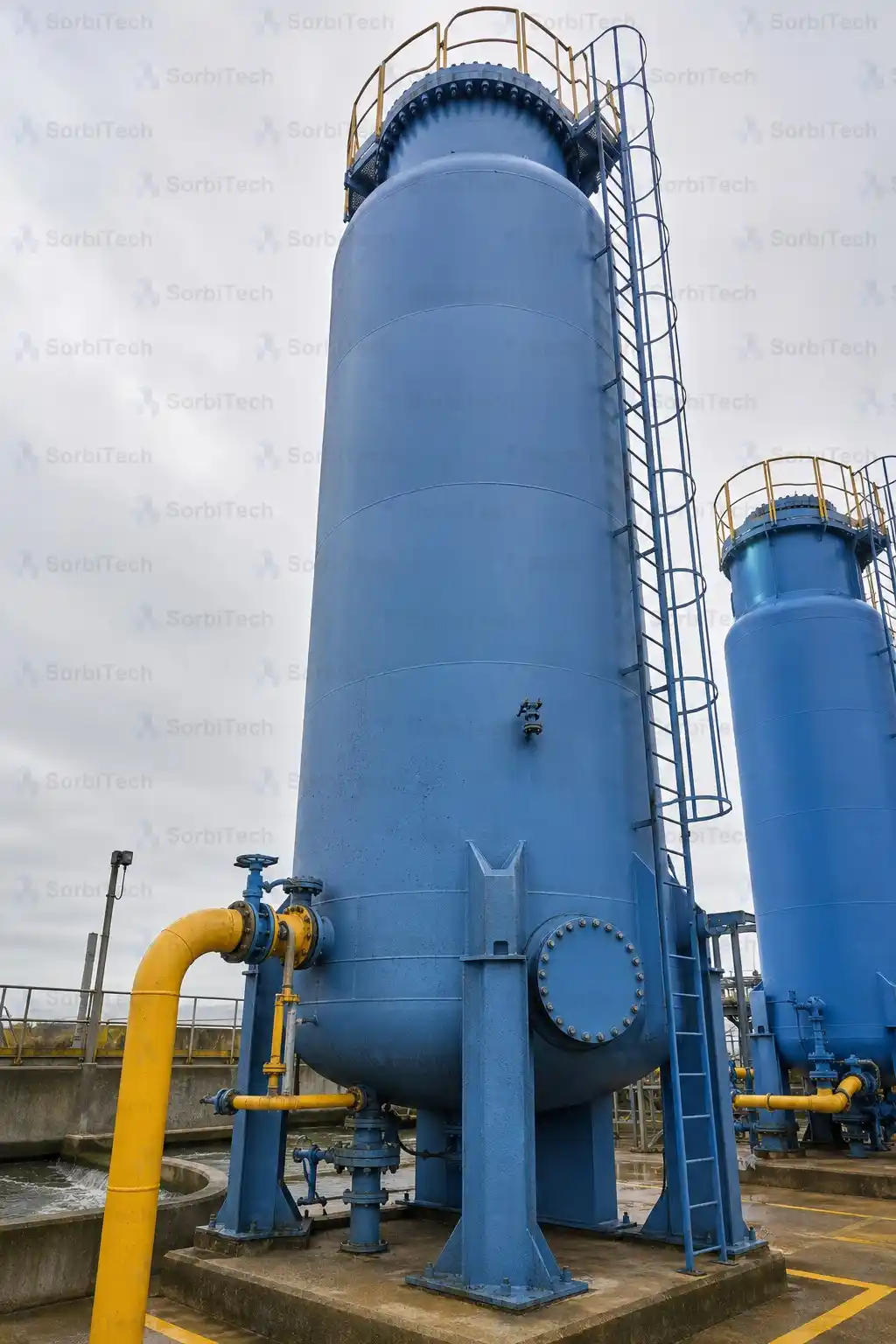
Activated Carbon Water Contactor
Granular activated carbon fixed bed water contactor for dechlorination, taste and odour, dissolved organic carbon, and emerging contaminant polishing in drinking water and process water.
Capacity: 5–2,000 m³/h

Sequential contaminant removal in three stages: suspended solids, dispersed oil, and dissolved organics, each addressed by the stage engineered for that class.
A single filtration stage cannot address all three contamination classes in a mixed stream. Suspended solids blind a coalescing media bed within hours of operation. Dispersed oil droplets, too fine for gravity separation, pass a sand filter unchanged and foul an activated carbon bed. Dissolved organics are invisible to both the filter and the coalescer. SorbiTech designs the three stages in sequence so each stage receives the inlet conditions it was sized for, and each produces the outlet conditions the next stage requires.
The multi media pressure filter operates at 5 to 15 metres per hour through a graded bed of anthracite, sand, and garnet. Coarser solids load near the surface. Finer particles penetrate deeper before the bed reaches capacity. Differential pressure across the bed rises as solids accumulate. At the trigger setpoint the controller initiates automatic backwash, restores the bed, and returns the filter to service. The outlet turbidity after backwash runs below 1 NTU at the rated throughput.
The coalescing stage downstream receives the clarified stream and concentrates on the dispersed oil fraction that the filter passed. High surface area fibrous media cause fine oil droplets to merge, grow to separable size, and rise to a collection weir. The outlet from the coalescer, typically below 10 mg per litre, feeds the activated carbon contactor where dissolved hydrocarbons, chlorinated species, taste and odour compounds, and organic micropollutants adsorb in the carbon micropore network to the contracted outlet concentration.
The engineering discipline in a filtration train is sizing each stage to the inlet it receives. The filter outlet is the coalescer inlet. The coalescer outlet is the carbon inlet. A miscalculation at any stage overloads the next. SorbiTech closes the mass balance across all three stages before committing to the outlet specification.
In a multi media filter, depth filtration distributes the solids holding load through the full bed depth. The anthracite layer at the top retains particles above 40 micron. The fine sand in the middle zone retains particles between 10 and 40 micron. The garnet at the base protects the underdrain and extends the service cycle. Superficial velocity is maintained below the fluidisation point of the garnet layer. Backwash expands the bed in reverse flow, releases the collected solids, and resets the graded profile.
In the coalescing stage, oil droplets between 10 and 200 micron arrive suspended in the clarified water from the filter. The high surface area media provides the physical contact required for small droplets to meet, attach, and grow to a size where buoyancy exceeds the drag force of the flowing water. Coalescence occurs at the media surface. Grown droplets rise freely to the oil collection trough above the media pack. The activated carbon contactor that follows operates by van der Waals attraction and electrostatic interaction between dissolved organic molecules and the carbon surface, which presents the required contact area in the micropore network at the design flow rate.

SorbiTech assembles filtration systems on a structural skid frame in the workshop. The pressure vessel, internal distribution manifold, backwash collector, piping, instrumentation, and media charge are fitted and pressure tested before the skid leaves the workshop. Instrumentation loops are checked against the PLC before shipment. Civil tie-in and utility connection are the only site activities before commissioning.
Vessel material follows the inlet chemistry. Carbon steel with internal epoxy lining for standard produced water and general effluent service. Grade 316L stainless for contact with chlorinated water or mild corrosive media. Duplex 2205 to NACE MR0175 for sour service with hardness controlled welds. The media loading report, the first backwash commissioning procedure, and the carbon exchange programme are included in the as-built package.
Each system page carries the duty specification, the media grade, the vessel configuration, and the engineering selection guidance for that equipment type.
Granular activated carbon fixed bed water contactor for dechlorination, taste and odour, dissolved organic carbon, and emerging contaminant polishing in drinking water and process water.
Capacity: 5–2,000 m³/h
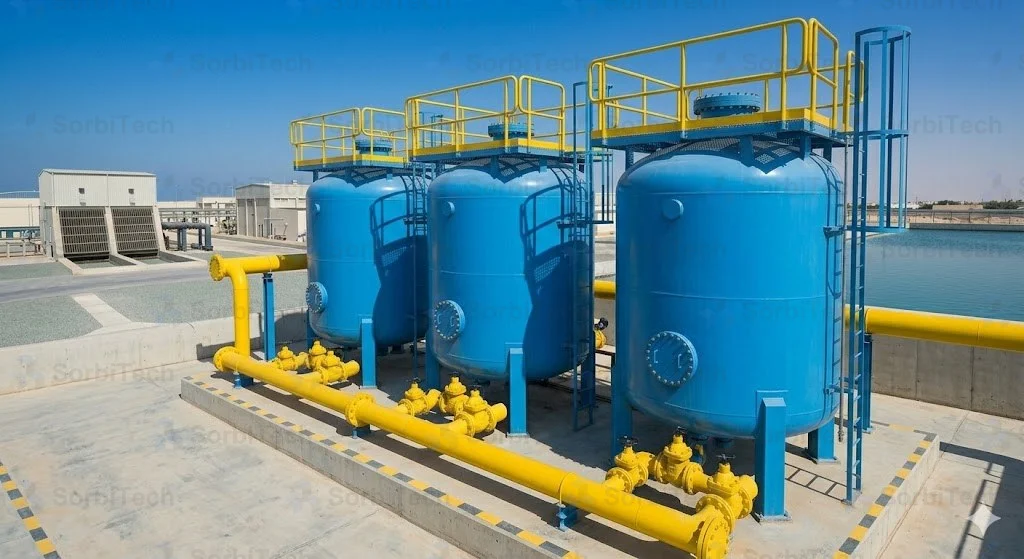
Multi media filter for suspended solids and turbidity removal upstream of activated carbon polishing, reverse osmosis, or process reuse in water treatment trains.
Capacity: 5–500 m³/h
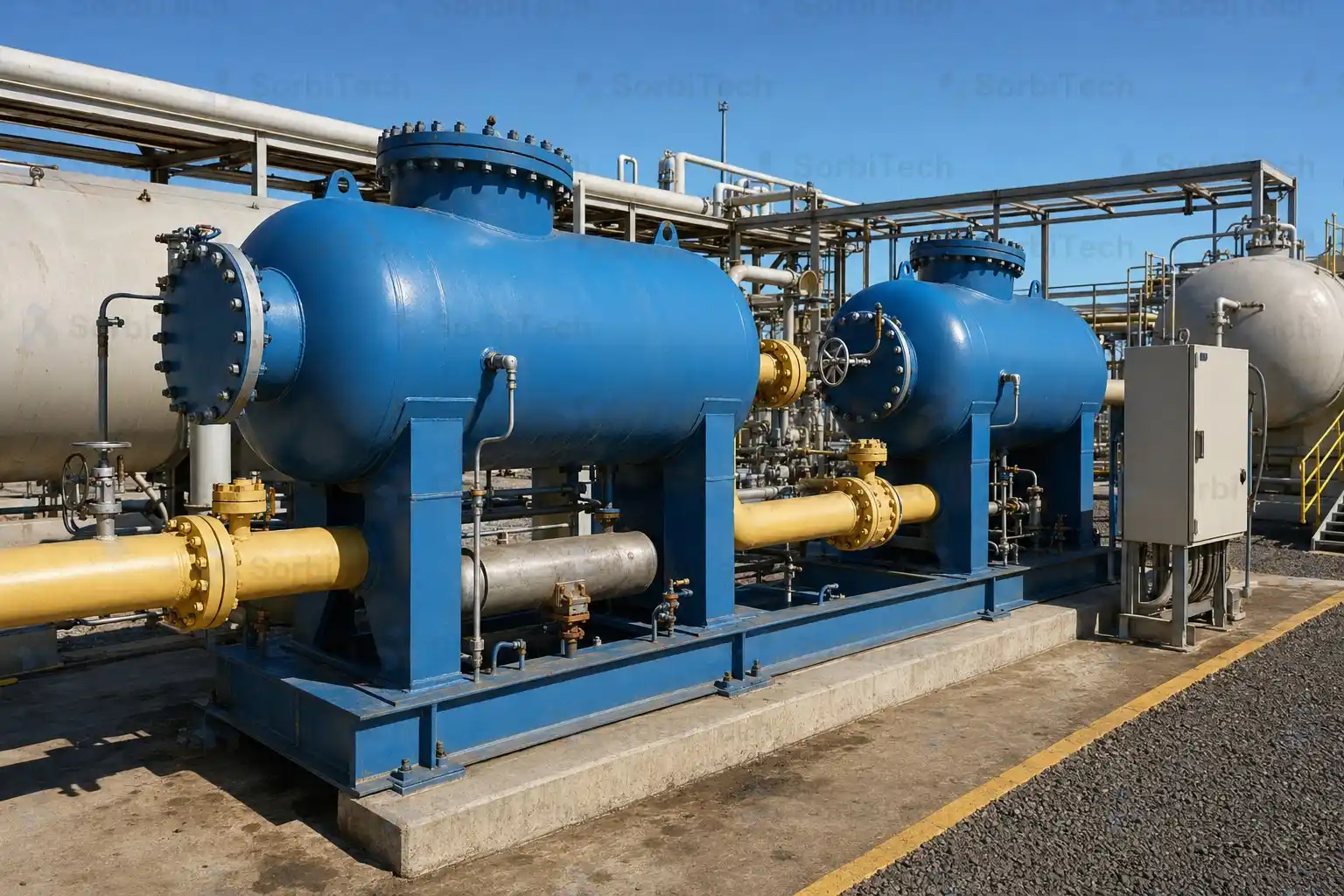
Two stage coalescer and separator skid that removes fine dispersed hydrocarbons and solids from water down to single digit ppm. It is the polishing stage after gravity separation.
Capacity: 2–200 m³/h
When the adsorbent specification and the vessel design come from different suppliers, the performance guarantee has a gap between them. SorbiTech closes that gap by calculating both in one engineering record.
The adsorbent grade, the bed volume, the vessel wall thickness, and the cycle parameters are solved in one engineering calculation. The media specification is not issued separately from the equipment specification. There is one calculation record and one performance guarantee.
The contracted outlet condition, whether a dew point in degrees C, an oil concentration in mg per litre, or a product purity in percent, is the guarantee. SorbiTech measures the outlet at commissioning against the stated inlet conditions and issues the guarantee against the measurement.
All pressure vessels are fabricated to a named pressure vessel code. Third party inspection is appointed for all vessels regardless of pressure class. NACE MR0175 materials and post weld heat treatment are applied to sour service duty without a separate qualification process.
Scheduled media sampling and laboratory activity testing track bed performance against the design specification. When the bed reaches the end of its service life, the reload is carried out under the original process calculation. The performance guarantee restarts after reload.
Starting point for the engineering conversation. The final specification closes after SorbiTech receives the inlet composition, the operating window, and the target outlet condition.
A multi media filter uses three graded materials: anthracite above sand above garnet, with decreasing grain size from top to bottom. The graded profile allows particles to penetrate deeper into the bed before loading reaches capacity. This increases the solids holding volume per unit of vessel cross section compared with a sand filter at the same superficial velocity. The result is a longer service run before backwash is required and a lower outlet turbidity at the rated throughput.
By the differential pressure rise across the media bed. A clean bed at rated flow produces a baseline pressure drop of 0.1 to 0.2 bar. As solids accumulate, the resistance increases. When the differential pressure reaches the setpoint, typically 0.3 to 0.5 bar above the clean bed baseline, the PLC initiates backwash automatically. SorbiTech measures the actual baseline at commissioning and sets the trigger against the real clean bed reading.
When the inlet stream contains dispersed oil between 10 and 200 mg per litre and the required outlet is below 10 mg per litre. A media filter removes suspended solids and free oil droplets above approximately 150 micron. It does not remove finer dispersed droplets. The coalescing stage handles the dispersed fraction that the filter passes and delivers the clarified outlet the carbon contactor requires to operate within its design loading.
Coconut shell granular activated carbon with an iodine number of 1000 to 1200 mg per gram, certified to NSF ANSI 61 for direct drinking water contact. The coconut shell precursor delivers higher micropore volume and lower extractable ash than coal based carbon of equivalent apparent density. Coal based GAC is used where a broader pore size distribution is needed to adsorb larger molecules such as humic substances or PFAS compounds from surface water sources.
Six to twelve months on industrial effluent polishing at the rated inlet loading. Two to three years on drinking water service with low organic carbon and well prepared upstream filtration. Carbon usage rate, expressed in kilograms per cubic metre of water treated to the outlet specification, is the design variable that determines the exchange interval. A field sample at three months confirms the actual rate against the design assumption.
Provide your duty conditions and our team will recommend the right system configuration, media grade, and delivery scope.
Tell us briefly what you need. Our technical team responds within one business day.
Request the TDS / datasheet. We send it on email after a brief review.